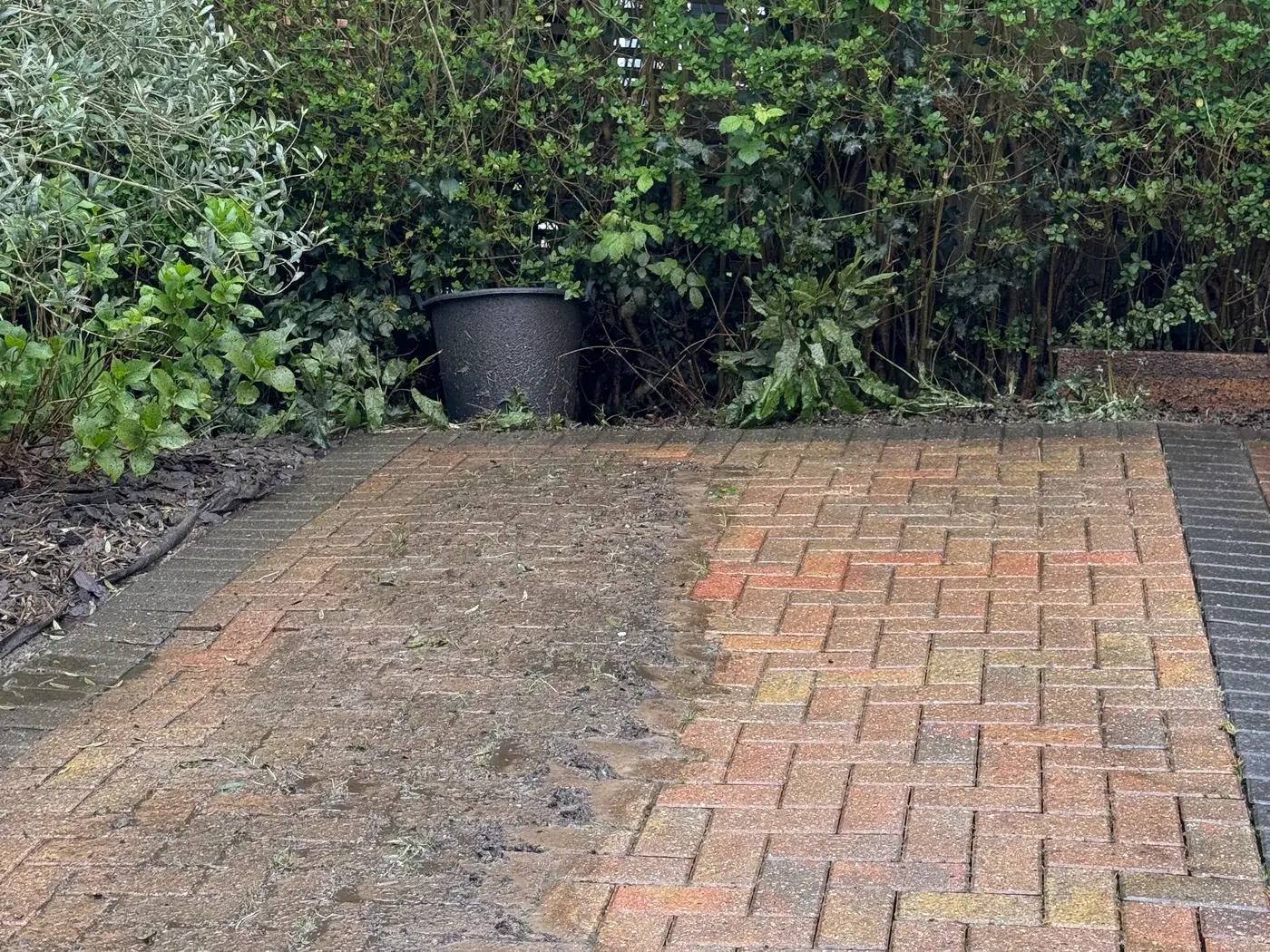
The most common complaint we hear about a previous driveway clean is that it looked superb for one summer and green by the following spring. That is not bad luck. It is what happens when a drive is washed and nothing else.
Moss on block paving does not live on the block. It lives in the joint.
Why the joints are the problem
Block paving is bedded on sand and jointed with sand. Over the years that jointing sand washes out, and what fills the gap is organic silt — leaf litter, roof grit, dust. That is a perfect seed bed, damp and sheltered, and it is where moss and weeds establish.
Pressure washing blasts the visible moss off and, at the same time, empties whatever sand is left in the joints. If nothing goes back in, the joints refill with silt over the next few wet months and you are back where you started, faster than before.
The three steps that actually work
A driveway clean that lasts has three parts, and most short-lived cleans skip the last two.
- Rotary pressure clean the surface evenly — no striping, no gouged edges.
- Apply a biocide across the whole area to kill the spores and root material left in the joints.
- Re-sand the joints with kiln-dried sand, brushed and vibrated in so the blocks re-interlock.
Why kiln-dried sand matters
Kiln-dried sand is graded and genuinely dry, so it runs into the full depth of the joint rather than bridging at the top. That restores the structural interlock that stops blocks rocking under a car wheel, and it leaves far less room for organic material to settle.
Building sand or damp sharp sand does not do the same job and tends to stain the block faces.
Sealing: worth it or not?
Sealing a block drive after cleaning and re-sanding does help. It stabilises the joint sand, resists oil staining, and slows re-growth. It is an added cost and it needs redoing every few years, so it makes most sense on a drive you have just had fully restored, on light-coloured blocks, or where oil drips are an ongoing annoyance.
Sealing a drive that has not been properly cleaned and dried first traps the dirt underneath. Timing matters more than product choice.
What you can do between visits
Keep leaf litter swept off through autumn — that alone slows the silt build-up more than anything else you can do. Trim back planting that keeps a section permanently shaded, and clear the drainage channel so water is not standing on the paving.
A light biocide top-up between professional cleans is inexpensive and stretches the interval considerably.
The short version
- Moss lives in the joints, not on the blocks.
- Washing alone gets you one season; biocide plus re-sanding gets you years.
- Kiln-dried sand restores interlock as well as blocking regrowth.
- Sweeping autumn leaves off is the highest-value thing a homeowner can do.